- +91 95890 15575
- office@lumierefenestration.com

Welcome to Ascendia
uPVC Slide and Fold Windows
+91 95890 15575
What are uPVC slide and fold windows?
A uPVC slide and fold window is a multi-panel opening system where each panel slides along a precision-engineered track and folds neatly to one side — clearing the full width of the opening rather than just a portion of it.
Unlike standard sliding windows, which are always partially obstructed by fixed panels, a slide and fold system stacks completely to one end. The result is an uninterrupted opening that connects interior spaces directly to balconies, patios, gardens, and sit-outs — without any frame interrupting the threshold.
Each panel moves on precision rollers, folds on structural hinges, and locks at multiple points when closed. The system handles wide spans — from compact three-panel configurations to six-panel arrangements spanning several metres — while maintaining the same structural rigidity, weather sealing, and operational ease across every configuration.
In Ascendia systems, this is not a door mechanism adapted to a window — it is a purpose-engineered opening system, designed from the profile outward to perform consistently across India's range of climatic conditions.
engineered as a system, not assembled as a product.
Ascendia’s Slide and Fold Windows (also known as sliding and folding windows) redefine how
modern Indian homes experience ventilation, openness, and unobstructed views.
Unlike standard sliders, these systems stack neatly to one side, creating a wide, free-flowing
opening ideal for luxury homes, balconies, patios, kitchens, and panoramic views.
Each panel glides smoothly on German precision rollers, folds with structural stability, and
locks securely with multi-point hardware — engineered for airtight sealing, weather
resistance, and long-term durability.
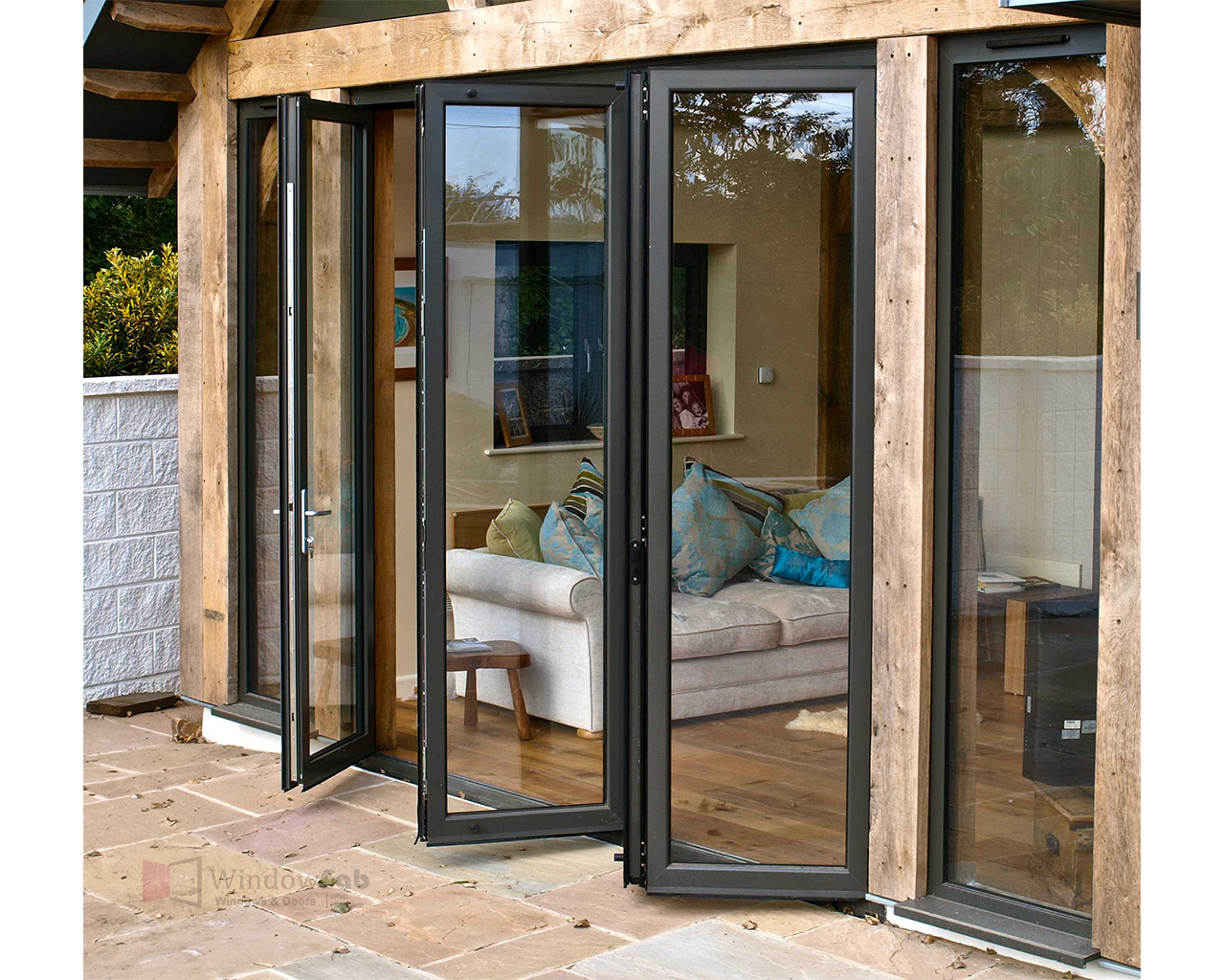
Designed for India’s tropical, coastal, and high-rise conditions, Ascendia slide & fold systems offer:
- wide, unobstructed openings
- German-engineered locking & roller systems
- noise, dust & weather insulation
- effortless sliding + folding movement
- premium elevation aesthetics
- grill & mesh compatibility
- decades of smooth, reliable performance
Why Homeowners & Architects
Prefer Slide and Fold Windows
And what makes Ascendia outperform all standard folding systems
Slide & fold windows are chosen for spaces where:
- a large opening is required
- panoramic views are important
- indoor–outdoor connection matters
- ventilation must be maximised
- elevation must look clean & modern
- balconies or decks need seamless access
Ascendia elevates this further with:
- Performance-oriented rollers and hinges backed by European technology (GU and Siegenia)
- smooth multi-panel stacking
- dual EPDM sealing for insulation
- Cold-formed reinforcement for structural rigidity
- marine-grade components for coastal regions
- compatibility with grills, mesh & safety systems
- Colour durability
Where slide and fold
windows perform best
Balconies
A balcony opening presents a specific challenge — the space between indoors and outdoors
needs to feel like a threshold, not a barrier. Standard sliding windows limit how much of that opening can actually be used. A slide and fold system removes the constraint entirely.
All panels fold to one side, leaving the full balcony width open. Ventilation is unrestricted. The view is unobstructed. And when closed, the system seals tightly against rain, dust, and noise — critical in urban apartments where balconies face roads, other buildings, or open corridors.
Ascendia slide and fold systems for balconies are specified with marine-grade hardware where humidity is a factor, double EPDM sealing for weather resistance, and glass options calibrated to the orientation — reflective where solar gain is a concern, laminated where noise is the priority.
Living room to patio or garden
This is the application the slide and fold system was built for. A wide living room opening to an outdoor space — a patio, a garden, a covered sit-out — requires a system that can disappear entirely when open and perform flawlessly when closed.
Ascendia systems in this context are typically configured as five or six-panel arrangements, with a split-fold option that stacks panels to both sides and creates a fully centred opening. The indoor-outdoor boundary becomes a choice rather than a fixed condition — open fully for gatherings, partially for daily ventilation, or closed completely without visual disruption to the elevation.
For villa and independent house applications, this configuration is also the most architecturally visible. The sightlines when closed, the stacking proportion when open, and the finish quality of the profiles directly affect how the space reads from both inside and outside the building.
Large kitchen and dining windows
Kitchens and dining areas benefit from controlled ventilation and natural light in equal measure — but the opening is typically window-height rather than door-height, and access to the outside is not the primary requirement.
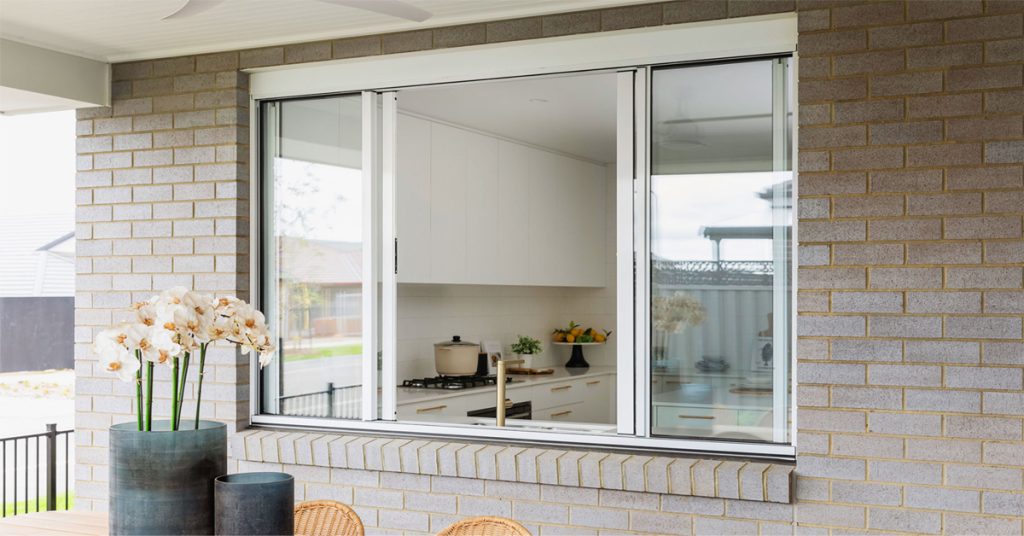
A window-style slide and fold configuration addresses this directly. Panels fold to one side to maximise the opening width, bringing in ventilation and light without a door threshold at floor level. It suits wide kitchen countertop windows, dining room openings that face a courtyard or garden, and upper-floor spaces where the priority is the view and airflow rather than physical access.
The system operates at window proportions with the same structural rigidity and weather performance as a full-height configuration — because the engineering is identical, only the frame height changes.
Villa sit-outs and covered terraces
Sit-outs and covered terraces in villas are transitional spaces — neither fully indoors nor fully outdoors — and the opening system that defines them shapes how the space functions across seasons.
In the monsoon, a sealed, weather-resistant closure keeps the sit-out usable. In cooler months, a fully open configuration extends the living area into the terrace without physical interruption.
Ascendia slide and fold systems in this context are designed to handle both conditions with the same hardware — no seasonal adjustment, no compromise on sealing performance when closed, and no resistance in the mechanism after years of daily use.
For sit-outs with wide structural openings, the six-panel configuration with a designated daily-access door panel is the most practical arrangement — the full system can be opened when needed, but routine access does not require operating every panel each time.
High-rise apartments
At elevation, the demands on a slide and fold system increase. Wind load, pressure differential, and the frequency of operation are all higher in a high-rise context — and the consequences of hardware failure or seal degradation are more immediately felt.
Ascendia systems for high-rise installations are reinforced at the profile level with cold-formed GI steel and specified with hardware rated to EN 13126 for 25,000 operating cycles. Multi-point locking distributes closure pressure evenly across the sash, which directly improves both wind resistance and airtight sealing. The system is not modified for high-rise use — it is engineered to meet those conditions as a baseline.
Ascendia Slide & Fold Engineering
Performance Designed at the System Level
Most slide & fold uPVC windows fail for a simple reason — they are put together, not thought through.
Ascendia Slide & Fold uPVC Windows are designed as a complete system. The frame, the rollers, and the locking points are planned to work together from the start. That’s what keeps the window stable, smooth, and secure even after years of regular use.
This matters more in large openings, where weight, movement, and alignment issues show up very quickly if the system is not designed properly.
For critical movement and locking functions, Ascendia integrates proven German hardware systems from GU and Siegenia to ensure smooth operation, security, and durability.
Supported by precision German hardware
With slide & fold windows, movement is usually the first thing to deteriorate. Panels start feeling heavy. Noise creeps in. Operation becomes uneven.
Ascendia addresses this at the design level. The smooth-glide system is built to handle panel weight and repeated daily operation without losing ease of movement over time.
Slide & fold movement remains smooth even with large glass panels
Heavy-duty rollers built for regular, long-term use
Quiet operation with controlled movement, not sudden jerks
Tested for 25,000 operating cycles (EN 13126) to verify durability
Multi-point locking integration
Security in slide & fold uPVC windows is not only about how many locks are added. It depends on how evenly the window closes and holds its position.
Ascendia’s multi-point locking system distributes pressure across the sash, which improves sealing, reduces movement under wind load, and strengthens resistance against forced entry.
Multi-point locking for improved break-in resistance
Even pressure distribution for tighter closure and better sealing
Reduced vibration and noise during strong winds
Designed to maintain alignment and locking performance over years
Engineered for the Indian Climate
Slide & fold windows need robust hardware and structural stability. Ascendia uses:
- UV-stabilised European uPVC profiles
- marine-grade rollers & hinges for coastal durability
- double EPDM sealing for dust, sound & rain
- multi-chamber insulated profiles
- GI steel reinforcement for structural strength
- optimised drainage channels to prevent water ingress
- Colour and profiles powered by Renolit Exofol apex
Created to withstand high humidity, heavy rain, coastal winds, heat, and long-term UV exposure for 30–40 years.
Slide & Fold Window Variants & Applications
Ascendia Slide & Fold uPVC Windows can be configured in different ways depending on how the opening is used in real life. The same system adapts to wide openings, daily access points, and large window spans — without forcing a single fixed layout.
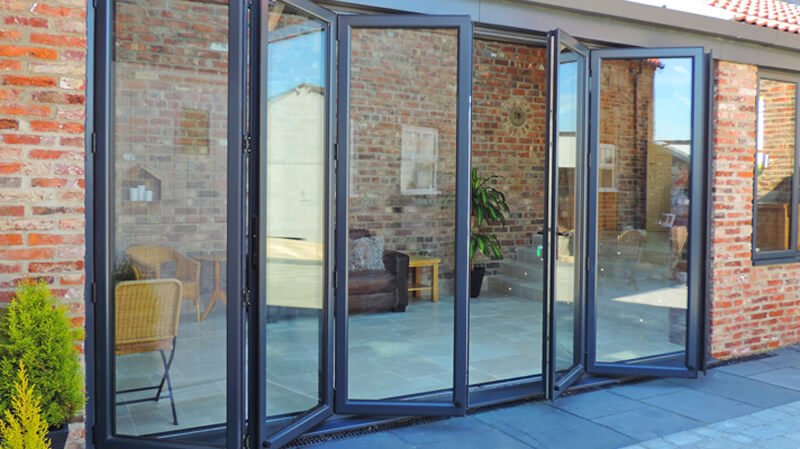
Full-Opening Slide & Fold Configuration
In this configuration, three panels slide and fold to the right and three panels slide and fold to the left. When fully opened, the centre portion is almost completely clear, creating a very large, unobstructed opening.
Where this works best:
- Large living rooms opening to balconies or gardens
- Villas with wide sit-out or patio areas
- Spaces where maximum airflow and openness are required
This setup is chosen when the priority is to visually and physically connect indoor and outdoor spaces, especially in homes with wide structural openings.
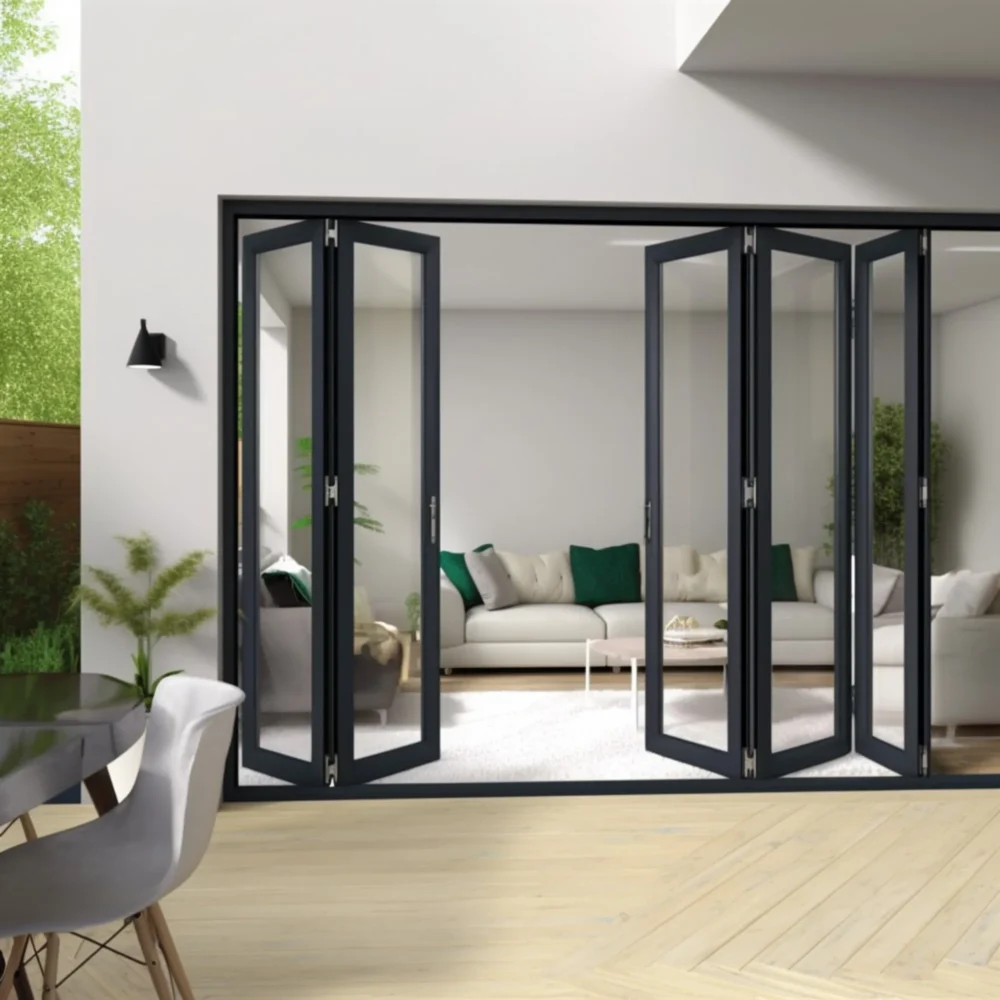
Daily-Use Door + Folding Panels Configuration
Where this works best:
- Homes with frequent balcony or patio access
- Living rooms where the opening is used multiple times a day
- Spaces that need convenience without opening all panels each time
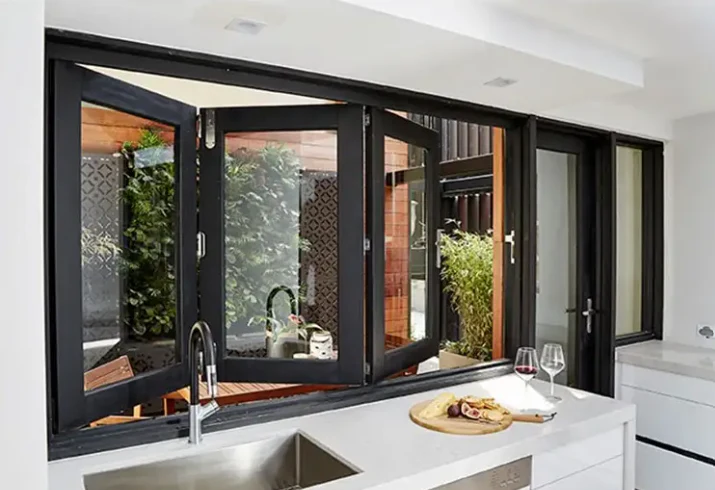
Large Window-Style Slide & Fold Configuration
Slide & fold systems can also be designed in window-sized formats, where the opening is wide but does not require door access. Panels fold to one side, allowing ventilation and openness while maintaining a window-style layout.
Where this works best:
- Large living room or dining room windows
- Upper-floor openings
- Homes requiring wide windows rather than door access
This option is ideal for large openings where standard sliding windows feel restrictive, but a full-height door system is not needed.
Why This Flexibility Matters
Instead of forcing one fixed use case, Ascendia Slide & Fold uPVC Windows adapt to how the space is actually used. Whether the requirement is a wide open façade, a convenient daily access point, or a large-span window, the same system can be configured to suit different needs without compromising usability or performance.
Performance That Matters Daily
- wide openings for natural ventilation
- 20-30 dB noise reduction
- dual EPDM weather sealing
- smooth German glide mechanisms
- Cold formed GI Reinforcement
- anti-rust, anti-corrosion hardware
- engineered specifically for Indian climatic stress
- High end security with laminated glass
Your windows shouldn’t just look premium they must perform premium every single day.
Sizes, Configurations & Customization Options
Every system is measured digitally and fabricated with laser calibration for an exact fit.
Configurations
- 3-panel, 4-panel, 5-panel, 6-panel systems” to “4-panel, 5-panel, 6-panel systems
- slide to left / slide to right
- split folding options
- slide & fold with fixed combinations
- tall openings up to architectural height
Colours
- premium white
- anthracite grey
- black
- golden oak
- walnut
- mahogany
- matte architectural finishes
Glass Options
- Toughened
- Laminated (noise reduction)
- DGU / Insulated
- Reflective
- Frosted privacy Glass
What determines the cost of a slide and fold window system?
A uPVC slide and fold window is a configured system, not a catalogue product. The cost of any installation reflects the specific combination of opening dimensions, panel count, glass specification, hardware grade, and installation complexity that the project requires. No two projects are identical — and a price that does not account for these variables is not a price you can rely on.
The factors below are what Ascendia evaluates when building a project specification. Understanding them helps set realistic expectations before a site visit is arranged.
Opening width and height
The structural opening is the starting point for every cost calculation. A wider opening requires more panels, longer profile runs, and heavier-duty reinforcement to maintain rigidity across the span. Taller openings increase the glass area per panel and the load on the roller and hinge hardware. Both dimensions affect material volume, fabrication time, and installation complexity in direct proportion.
Number of panels
Panel count is directly linked to opening width and the stacking configuration chosen. A three-panel system and a six-panel system covering the same opening width are structurally and mechanically different products — more panels means more hinges, more locking points, more rollers, and a more complex fabrication process. The configuration also affects how the system stacks when open, which has implications for the usable space on either side of the opening.
Glass specification
Glass is typically the single largest cost variable in a slide and fold system. The specification depends on what the opening needs to do — not just what it needs to look like.
Toughened glass is the baseline for safety in large panels. Laminated glass adds acoustic and security performance. Double-glazed units introduce a thermal insulation layer that reduces heat gain and sound transmission simultaneously. Reflective glass manages solar gain in west or south-facing openings. Each step up in glass specification increases both material cost and panel weight — which in turn influences the hardware grade required to support it.
Hardware grade
The rollers, hinges, locking systems, and track components that operate a slide and fold system are not interchangeable. Hardware grade determines how smoothly the system operates on day one — and how well it continues to operate after years of daily use.
Ascendia integrates German hardware from GU and Siegenia across its slide and fold range. For coastal installations, marine-grade variants of all moving components are specified. The hardware is not a finishing detail — it is a structural part of the system, and its specification is determined by panel weight, opening size, and environmental exposure.
Colour and finish
Ascendia profiles are available in premium white, anthracite grey, black, and a range of wood-grain finishes including golden oak, walnut, and mahogany. Standard white profiles are the base specification. Foiled finishes — applied using Renolit Exofol Apex — carry an additional cost that reflects the material and process involved. For projects where the window finish is a visible architectural element, the premium is typically considered part of the design budget rather than the window budget.
Installation complexity
A prepared opening in new construction and a retrofit into an existing structure are different installation contexts. Irregular openings, masonry conditions, floor-level thresholds, and access constraints at height all affect the time and skill required to install and calibrate the system correctly. Ascendia installations are carried out by in-house trained technicians — digital measurement and laser alignment are standard, not optional — because installation quality directly determines long-term performance.
Every Ascendia slide and fold system is priced after a site visit and digital measurement — because an accurate price requires accurate information. If you have an opening in mind, the most useful next step is a consultation where dimensions, specification, and configuration can be assessed together.
Why Ascendia for Slide & Fold Windows
Each unit is built with European design principles and structural reinforcement.
Ensures perfect installation, smooth glide, and airtight sealing.
No subcontracting — only trained Ascendia technicians.
Siegenia / G-U systems
European EPDM
GI reinforcement
marine-grade screws & fittings
10-year comprehensive system warranty
20-year weathering warranty
End-to-end service
Frequently Ask Questions
What are uPVC slide and fold windows?
A uPVC slide and fold window is a multi-panel system where each panel slides along a precision track and folds neatly to one side, creating a wide, unobstructed opening. Unlike a standard sliding window — which only opens partially — a slide and fold system can clear almost the entire opening width, making it the preferred choice for balconies, patios, and large living spaces where full ventilation and indoor-outdoor connection matter.
How are slide and fold windows different from standard sliding windows?
A sliding window moves panels horizontally on a track but always leaves at least one fixed panel in place — the opening is limited to roughly half the total frame width. A slide and fold system eliminates this constraint entirely. All panels fold and stack to one side, clearing the full opening. For wide spans where ventilation, access, and view are priorities, slide and fold systems are the structurally correct choice. Standard sliding windows are better suited to smaller openings where partial ventilation is sufficient.
How many panels can an Ascendia slide and fold system have?
Ascendia slide and fold systems are configured in 3, 4, 5, and 6-panel arrangements. The right panel count depends on the structural opening width, the intended use — whether the priority is a full-open façade, a combined door-plus-window layout, or a large window-style application — and the stacking direction. Each configuration is measured digitally and fabricated as a complete unit, not assembled from standard components on site.
Can slide and fold windows be installed with grills or mesh?
Yes. Ascendia slide and fold systems are fully compatible with both grill and mesh integration. Pleated mesh and sliding mesh options are available for insect protection without compromising ventilation. Grill configurations can also be incorporated where security or aesthetic requirements call for it. Both are designed and fitted as part of the system — not added as afterthoughts — to ensure consistent operation and finish.
How much noise reduction do slide and fold windows provide?
With laminated or double-glazed units, Ascendia slide and fold systems deliver 25–30 dB of noise attenuation. Performance depends on glass specification — laminated glass is the more effective option for acoustic control, while DGU with an appropriate air gap provides a balance of thermal and acoustic insulation. For spaces adjacent to roads, common areas, or high-ambient environments, glass specification should be discussed at the design stage.
Are slide and fold systems suitable for coastal and high-humidity regions?
Yes, and this is a consideration Ascendia addresses at the component level. The hardware used in coastal installations is marine-grade — corrosion-resistant rollers, hinges, and fixings that do not degrade under salt air or sustained humidity. UV-stabilised uPVC profiles maintain their colour and structural integrity without surface treatment. The system is built for Indian conditions, including coastal Kerala, where heat, humidity, and salt exposure are constants rather than exceptions.
What glass options are available for slide and fold systems?
Ascendia slide and fold systems support toughened, laminated, double-glazed units (DGU), reflective, and frosted glass. The appropriate specification depends on the application — toughened glass for structural safety in large panels, laminated for noise and security, DGU for thermal performance in air-conditioned spaces, and reflective or frosted where privacy or solar control is required. All glass is specified as part of the system design, not selected independently.
How do I maintain an Ascendia slide and fold system?
Routine maintenance is minimal. The track and rollers should be cleaned periodically using a soft brush to remove dust and debris — this is the primary cause of resistance over time. A light application of silicone-based lubricant on the rollers every 12–18 months maintains smooth operation. The uPVC profiles require only a wipe-down with mild soapy water. Avoid abrasive cleaners on the profiles and solvent-based products on the seals. No repainting, no anti-rust treatment, and no seasonal upkeep are required.
Can slide and fold systems be installed in high-rise buildings?
Yes. Ascendia slide and fold systems are designed with cold-formed GI reinforcement and multi-point locking hardware that provides structural stability under wind load conditions common to high-rise applications. Hardware is tested to EN 13126 standards across 25,000 operating cycles. For elevated installations, the system specification — particularly glass thickness, reinforcement profile, and fixing method — is assessed on a per-project basis to ensure performance under the specific wind exposure of the floor level and orientation.
How long does installation take?
Installation time depends on the number of panels, opening dimensions, and site conditions. A standard 4–5 panel system in a prepared opening typically takes one to two days — including digital measurement, final fitting, hardware calibration, and commissioning. Ascendia installations are carried out by in-house trained technicians, not subcontracted labour, which means the fabrication tolerances and installation precision are held to the same standard throughout.
What is the warranty on Ascendia slide and fold systems?
Ascendia slide and fold systems are covered by a 10-year comprehensive system warranty and a 20-year weathering warranty on uPVC profiles. The system warranty covers the full assembly — hardware, seals, and profiles — not individual components in isolation. Post-installation service is handled directly by Ascendia, not through third parties. Warranty coverage reflects the long-term performance standard the system is engineered to meet.
Are slide and fold windows only for doors, or can they be used as windows too?
Slide and fold systems work effectively in both door-height and window-height configurations. Door-height applications are common for balcony access, patio openings, and villa sit-outs. Window-style configurations — where the opening is wide but does not require floor-level access — are equally well-suited to the system. The mechanism, hardware, and sealing are the same in both cases; only the sill height and frame proportions change. This makes slide and fold a versatile solution across different opening types within the same building.