An Ascendia guide to glass types, glazing build-ups and room-by-room selection
Most people spend weeks choosing a window profile and about four minutes choosing the glass inside it. That order is backwards. The frame holds things up; the glass is what you actually live behind. It decides how much daylight you get, how hard your air conditioner works, how much of the road you can hear at 6 a.m., and what happens if someone walks into it.
A west-facing living room, a bedroom over a main road and a shaded kitchen are three different problems. They should not end up with the same glass.
Every glazing decision at Ascendia comes down to three questions, asked in this order:
What type of glass? How is it built into the window? What finish or coating does it carry?
Answer those three, window by window, and you have a specification worth signing off on.
1. Glass type: start with safety
There are three options in normal residential work — ordinary clear, toughened and laminated.
One point causes constant confusion on site, so it’s worth settling early. Clear describes how the glass looks. Toughened and laminated describe how it’s made. Toughened and laminated glass can both be perfectly clear, and both can carry performance coatings. These are not competing categories.
Ordinary clear glass (annealed)
Cheap, transparent, and it breaks badly. Annealed glass fails into large, sharp shards, which is why its use has to be thought through properly for big panes, glazed doors and anything near floor level.
If ordinary glass is on your quotation purely because it was the lowest line item, that is not a specification decision. That’s a pricing accident.
Toughened glass
Heat treatment makes the glass considerably stronger, and when it does fail it generally breaks into small blunt fragments rather than shards. For a large share of residential windows it’s a sensible default, subject to pane size and the safety requirements of the opening.
Where it works well: standard windows with suitable safety provisions, kitchen and utility openings, bathroom windows paired with a privacy finish.
Where expectations run ahead of reality: toughening does nothing for heat or noise, and a broken toughened pane does not stay in the frame. It empties the opening.
Laminated glass
Two or more glass layers bonded to an interlayer. Crack it and the fragments mostly stay stuck to that interlayer, so the pane holds its shape instead of disappearing.
That behaviour matters for large or low-level windows, full-height glazing, balcony doors, ungrilled openings and staircase glazing.
Two cautions from experience. First, security and post-breakage performance come from the whole assembly — interlayer, frame retention, locks, anchoring — not from the word “laminated” on a quote. Second, laminated glass is not an automatic substitute for grills or fall protection. An open window is still an open window, whatever the glass is made of.
2. Glass fitment: how the glass sits in the window
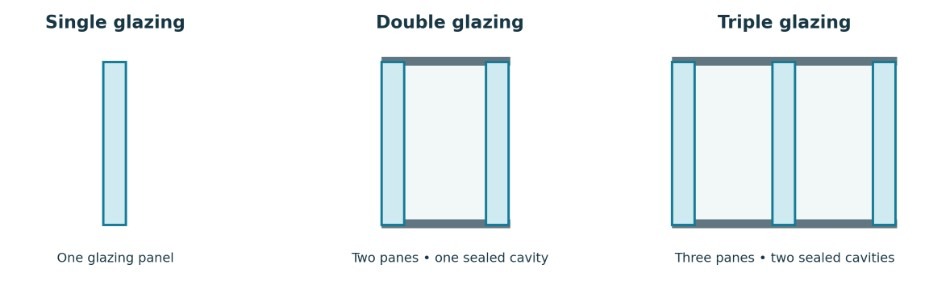
Fitment is the build-up — how many panes, and whether there’s a sealed cavity between them. It drives insulation, thickness, weight, and how hard the window system has to work.
Single glazing
One pane or panel, no sealed insulating cavity. That panel can still be toughened or laminated, clear or coated. This is where people get caught out: a laminated panel is still single glazing, even though it contains bonded layers. The bond isn’t a cavity.
Single glazing is lighter and usually cheaper. It suits shaded openings, naturally ventilated rooms and anywhere thermal insulation isn’t the priority. A performance coating on single glazing will cut solar heat gain, but it will not insulate the way a sealed unit does.
Double glazing (DGU)
Two panes, one sealed cavity. The cavity slows heat transfer, which is why a DGU is worth the money in bedrooms and living rooms that run on air conditioning most of the year.
The useful thing about a DGU is that it stacks functions. A single Ascendia unit can carry a solar-control coating on the outer pane, a sealed cavity for insulation, and laminated construction where fragment retention is needed. Acoustic performance can be built into the same unit through pane selection.
What a DGU does not do on its own is guarantee solar control or sound reduction. Those come from the specific panes, the coating and its position, the cavity, the seals and the quality of installation. “It’s double glazed” is a description, not a performance claim.
Triple glazing
Three panes, two cavities. Higher thermal performance, and also more thickness, more weight and more cost. It needs a window system built to carry it.
On most Indian residential projects, a well-specified DGU gets you most of the benefit for considerably less. Triple glazing earns its place only where there’s a defined performance requirement and the profile and hardware genuinely support the load.
3. Glass finish: coatings and performance
With type and fitment settled, the finish decides how the glazing handles solar heat, daylight, glare and reflection.
Clear finish. Neutral view, maximum daylight. A good starting point for shaded openings and rooms where solar gain isn’t the issue. Safety still governs whether it should be toughened or laminated. For anything sun-exposed, check the heat numbers before you settle on clear.
Solar-control glass. Coatings that limit the heat coming in with the sunlight. These matter most on exposed living rooms, east and west elevations and large glazed openings. Products worth putting on the table for an Ascendia specification include ST 167 and ET 125, along with suitable options from the COOL-LITE ST, SKN and XTREME ranges. Each strikes a different balance between daylight, heat rejection, colour and external reflection. Compare the exact proposed build-up, and confirm availability and processing compatibility before committing.
Low-E glass. Low-emissivity coatings reduce radiative heat transfer and come into their own inside a double-glazed unit. Planitherm and similar products are worth considering where insulation and daylight both matter. Some coatings combine Low-E with solar control — and for a genuinely sun-beaten room, you want a product that does both, not one that only insulates.
Privacy finish. Obscure, patterned or frosted glass for bathrooms and windows that face a neighbour’s wall. Privacy is a separate decision from safety, and it should be built into an appropriate toughened or laminated specification rather than treated as an alternative to one. Always look at a physical sample in realistic light. Frosting reads very differently in a showroom than it does at dusk in a bathroom.
4. Reading the performance numbers
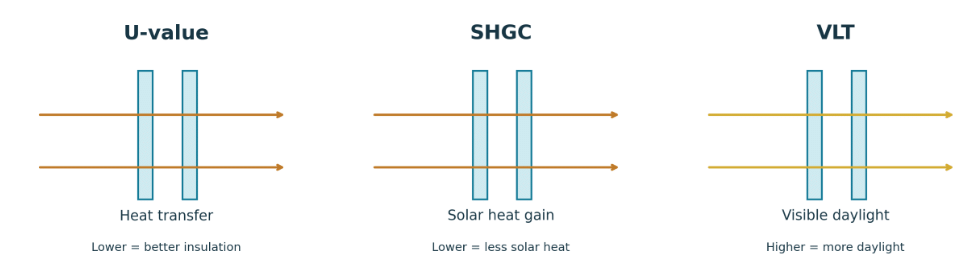
A sun-exposed living room usually wants a lower SHGC while holding on to useful daylight. A shaded bedroom tilts the other way, towards daylight and insulation.
One rule when comparing products: make sure you’re comparing like with like. Glass-only performance and whole-window performance are different measurements, and mixing them up flatters whichever product happens to be quoted the generous way.
5. Glazing by room
Treat these as starting points for a conversation, not answers. The actual opening, its exposure and its safety requirements decide the final call.
| Location or requirement | Glazing to consider | Why |
|---|---|---|
| Shaded, naturally ventilated bedroom | Clear toughened single glazing, where suitable | Daylight with a straightforward build-up |
| Regularly air-conditioned bedroom | DGU with an appropriate Low-E coating | Better thermal insulation |
| Road-facing bedroom | Laminated glazing or an acoustically designed DGU | Noise control matched to the performance needed |
| Road-facing, air-conditioned bedroom | DGU incorporating suitable laminated glass | Insulation and acoustics in one unit |
| Sun-exposed living room | Solar-control DGU, laminated where required | Solar heat, insulation and safety together |
| West-facing window | Low-SHGC glazing coordinated with shading | Manages afternoon heat |
| Ungrilled ground-floor opening | Laminated glazing with proper locks and anchoring | Fragment retention and security as one problem |
| Full-height window or balcony door | Safety glazing chosen for impact and retention, often laminated | Human contact and breakage consequences |
| Kitchen or utility window | Clear toughened, solar-control finish if exposed | Daylight, safety and exposure |
| Bathroom window | Safety glazing with a privacy finish | Privacy and impact protection |
| Staircase or low-level window | Engineered safety glazing, with guarding where required | Impact and fall risk |
| High-rise or wind-exposed opening | Construction and thickness set by engineering assessment | Pane size, support and wind pressure |
A practical note on noise-sensitive rooms. Glass alone won’t fix them. Seals, hardware and installation quality carry at least as much weight, and there’s no point specifying acoustic glazing into a window that doesn’t close tightly. If the plan depends on keeping windows shut, plan the fresh-air supply at the same time.
6. Specify the whole window, not just the glass
“Toughened glass” and “24 mm DGU” tell a fabricator almost nothing. Two units described as 24 mm DGU can perform completely differently.
A specification that can actually be priced and checked names:
- Glass type and thickness of each pane
- Laminated construction and interlayer, where used
- Cavity width and gas fill, if specified
- Performance coating and which surface it sits on
- Thermal, solar and acoustic data
- Compatibility with the chosen Ascendia window system
Written out properly, a DGU reads something like:
6 mm toughened outer pane with a specified performance coating + 12 mm sealed cavity + 6 mm clear toughened inner pane
That’s an example of the right level of detail. It is not a recommendation for every window in the house.
Finally, check the weight. Total glass thickness and mass have to suit the Ascendia profile, glazing beads, gaskets, reinforcement and hardware. Oversized panes and last-minute laminated upgrades frequently push a window into a different specification altogether, and it’s far cheaper to discover that on paper.
Getting it right for your home
Work outward from the room, not inward from the price list. A shaded kitchen may be perfectly served by clear toughened single glazing. A sun-exposed living room usually justifies a solar-control DGU. A bedroom over a busy road needs a glass build-up chosen specifically for acoustic performance, backed by seals that actually seal.
And where you have large ungrilled openings, safety and post-breakage retention belong in the conversation from the start, alongside comfort and appearance.
Plan your glazing opening by opening, combining type, fitment and finish to match how each room is used.
Send the Ascendia team your floor plan, along with notes on sunlight exposure, noise concerns and which rooms will be air-conditioned. Those three inputs shape the final window specification more than anything else.